Why an Industrial Heritage Museum Still Matters
A steam engine is never just a steam engine. It can tell us who had work, how food was grown, what children saw on their walk to school and why a town developed where it did. An industrial heritage museum makes those connections visible, turning large machines, factory records and familiar local streets into a story about people.
For towns shaped by manufacturing, transport or farming, this matters deeply. Industrial history is often described through inventions and production figures, but the real history took place in workshops, kitchens, pubs, schools and homes. It belongs to the engineer and the apprentice, the woman who took on wartime work, the farmer relying on new machinery, and the family whose daily life was organised around a factory whistle.
An industrial heritage museum keeps place in the picture
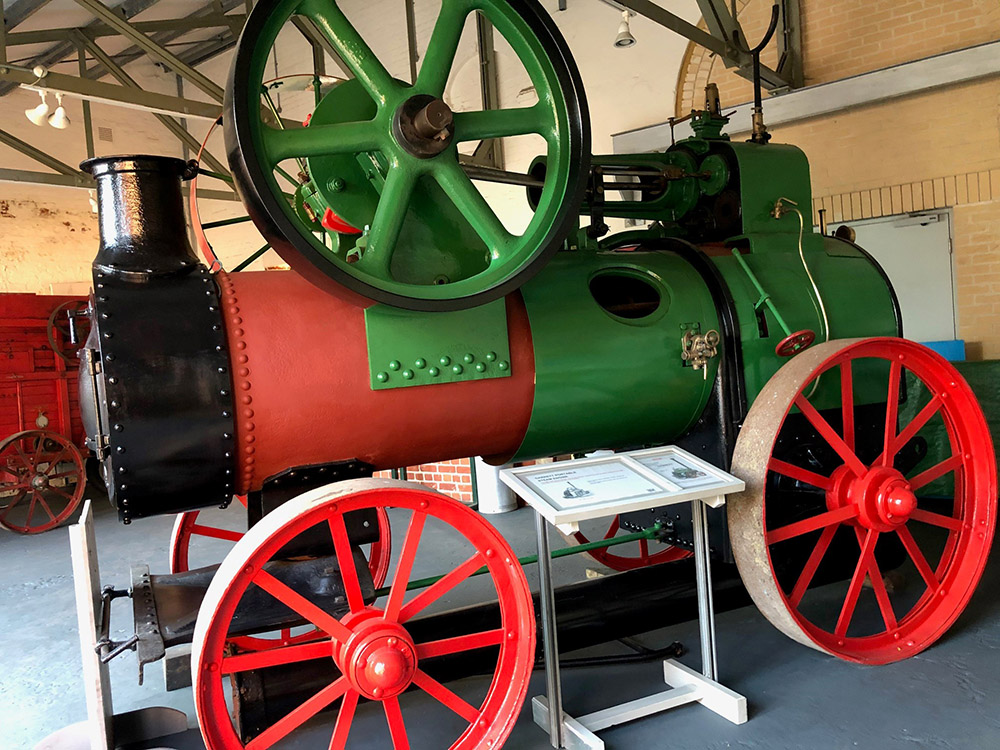
Industrial objects can look imposing, particularly to visitors who do not already know a boiler from a belt drive. Yet machinery becomes much easier to understand when it remains connected to the place and people that used it. A traction engine is not simply an impressive piece of engineering. It might have ploughed fields, hauled heavy loads, travelled to shows and provided vital work for local businesses.
That is why local collections have a particular value. They allow visitors to see how a national story – mechanisation, changing agriculture, the growth of factories or the pressures of war – played out in one community. The evidence is specific: a photograph of workers outside a gate, a wage book, a tool marked with an owner’s name, or an oral-history memory of a first day at work.
At the Long Shop Museum in Leiston, the history of the Garrett engineering works provides this essential local focus. The works were not separate from the town around them. They influenced livelihoods, skills, housing, family connections and the character of Leiston itself. Seeing that relationship helps explain why industrial heritage is also social heritage.
Machines are a route into human stories
There is genuine pleasure in seeing a well-preserved engine, tractor or piece of workshop equipment. For enthusiasts, its design, power and survival can be fascinating in their own right. Museums should respect that knowledge and the care behind it.
But an object has more to offer when it prompts questions. Who designed it? Who cast the metal, assembled the parts or maintained it? What skills were valued, and who had the chance to learn them? Did the work provide security, or was it demanding, dangerous and uncertain?
Factory life was rarely one simple experience. Employment could bring pride, regular wages and a strong sense of belonging. It could also involve noise, heat, long hours and strict discipline. The same works might be remembered fondly by one person and more cautiously by another. Good interpretation leaves room for both, rather than presenting the past as either a golden age or a tale of unbroken hardship.
This approach also makes a museum more welcoming to children and first-time visitors. A youngster may not immediately understand a complex machine, but they can understand the idea of a person learning a trade, helping their family, working with friends or adapting when a job changes. Technical history becomes a human story without losing its detail.
Industry changed the countryside as well as the town
Suffolk’s industrial past cannot be separated from its agricultural landscape. Engineering works supplied machinery that changed how land was cultivated, crops were processed and goods moved. New equipment could save labour and increase output, but it also altered the rhythms of rural work and the skills people needed.
These changes brought opportunities and trade-offs. Mechanisation made some jobs quicker and helped farmers respond to growing demand. At the same time, it could reduce the need for particular kinds of manual labour and reshape established communities. A museum that places farming alongside engineering can show both the ingenuity of the machines and the consequences of their arrival.
Transport tells a similar story. Roads, railways and steam power connected places more rapidly, allowing firms to send goods further afield and enabling workers, visitors and ideas to travel. Yet connection did not make every place the same. Local materials, local employers and local skills still gave towns their own identity.
Whose industrial history is being told?
The most useful industrial heritage museums look beyond the traditional image of the male engineer at the workbench. That image is part of the story, but it is not the whole of it. Women worked in factories, offices and homes, supported family economies, took on new roles during wartime and helped sustain community life in countless ways.
War changed industrial communities particularly quickly. Production could be redirected, workers might be called away, and women or younger people could enter roles previously closed to them. The consequences continued after peace returned. Expectations shifted, jobs changed again and families adapted to loss, return and rebuilding.
There are also stories that can be harder to find in the record. Not everyone left behind a diary, photograph or formal document. Museums have a responsibility to listen to local memories, question gaps in collections and make room for voices that older histories overlooked. This is not about forcing a modern view onto the past. It is about recognising that a community has always been made up of many experiences.
For visitors, this can be an invitation to look differently at their own family history. A surname in a census, an old workplace address or a relative’s trade may suddenly have a wider context. Even if a family has no direct connection to a particular works, the questions remain familiar: how did people earn a living, care for one another and respond to change?
Why seeing the real thing matters
Digital collections are invaluable. They can bring photographs, documents and objects to people who cannot visit, and they make it easier to research local history from home. They also help preserve fragile material by reducing handling.
There is, however, something distinct about standing beside a full-sized machine or walking through a historic industrial space. Scale changes understanding. The weight of cast iron, the height of a roof truss and the close arrangement of tools can reveal what a screen cannot. A building can hold traces of work in its layout, worn surfaces and atmosphere.
The strongest visitor experiences combine these approaches. Online access can encourage curiosity before a visit and keep a story going afterwards. On site, objects, demonstrations, family activities and conversations with volunteers can make that curiosity tangible. The right balance depends on the collection and the audience, but access should not be an either-or choice.
A shared responsibility for the future
Preserving industrial heritage takes practical effort. Large machinery needs specialist conservation, historic buildings need ongoing repair, and archives need careful cataloguing so that their stories can be found. These tasks are not always glamorous, but they are the foundation of everything visitors see.
Independent museums often rely on a mixture of admissions, retail income, donations, volunteers and community fundraising to do this work. Supporting a museum is therefore more than paying for a day out. It helps keep objects safe, develop learning opportunities and ensure local history remains available to future generations.
Volunteers are central too. They may welcome visitors, care for collections, research objects, share specialist knowledge or help at events. Their contribution shows that heritage is not something handed down by an institution alone. It is looked after collectively, with care and accountability.
The next time you visit an industrial heritage museum, start with one object and ask a simple question: whose hands made, used or depended on this? Follow the answer into the town, the fields and the homes beyond the museum walls. You may find that the past feels much closer than expected.


